


A journey through a loved one’s dementia diagnosis
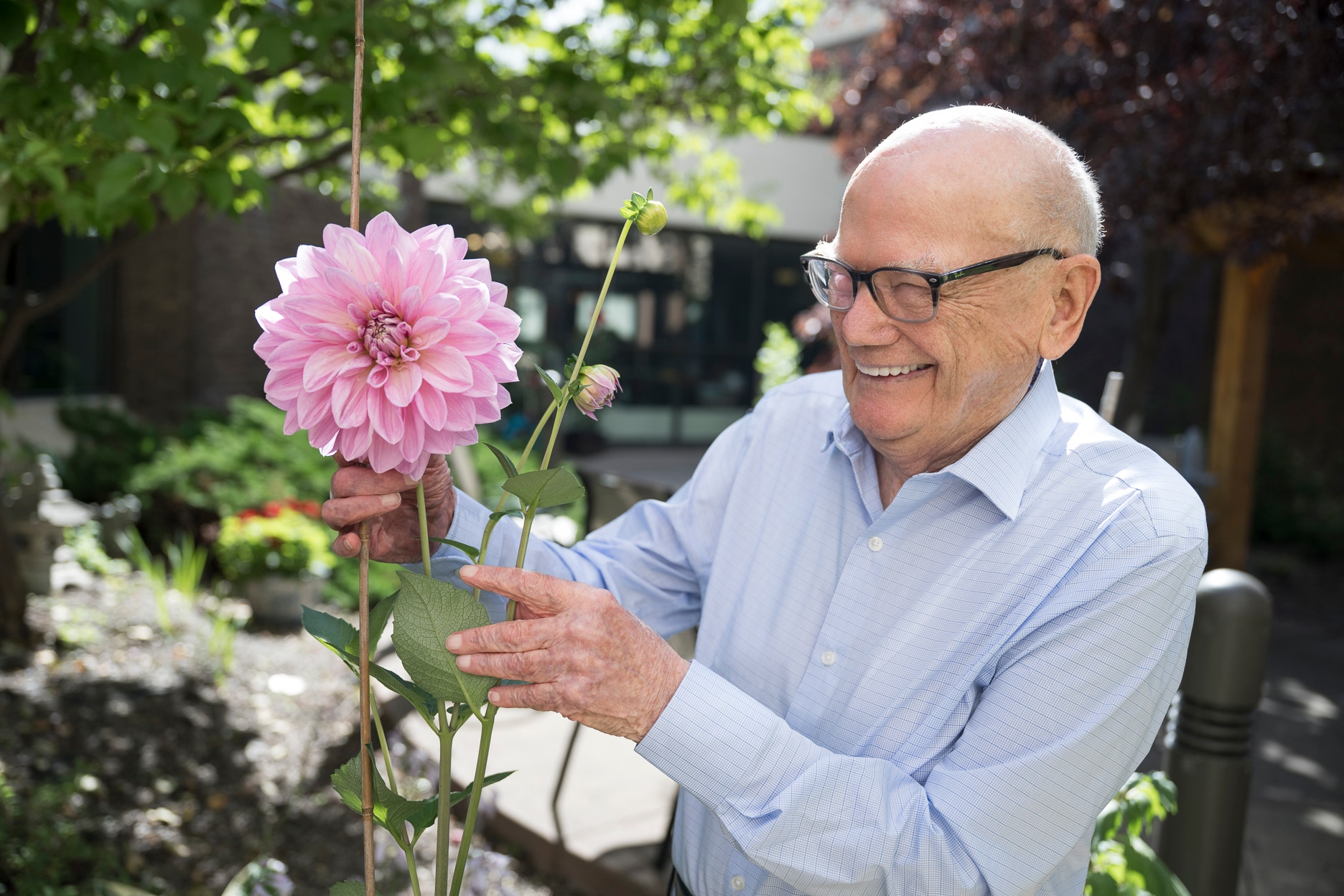


When you initially meet Ron, you’d never know he has ever experienced a bad day. Quick to smile, greet you with a warm hug, and share a laugh. His spark is punctuated with a quick wit — you’ll find yourself drawn to him as he regales tales of his daily adventures. And there are many.
Ron, 93, is always on the move: you’ll often see him enjoying a coffee with the fellow residents at Trinity Lodge, or tending to the colourful dahlias he plants in the courtyards — everything Ron does is driven by purpose.
Ron originally planned to move into Trinity Lodge to be closer to his wife, Joanie, who had transitioned to long-term care as her dementia progressed beyond what they could manage at home. Sadly, Joanie passed away before he could make the move. Faced with the decision to remain in his home or proceed with the transition he had planned before Joanie passed; Ron chose to move into Trinity Lodge.
“After Joanie passed away, I began to write down my memories, as a way to cope with my grief,” says Ron. “It helped immensely to help me process my thoughts, and I came out of it, not only feeling lighter, but having written a book. I self-published ‘Our Time to Say Goodbye’ on Amazon and decided to donate the proceeds to the Alzheimer Society.” Ron continues, “From there, I have chosen to get involved with a number of charitable initiatives – both at Trinity Lodge, and with organizations like the Alzheimer Society, the United Way and the Veteran’s Food Bank.” Ron shares that his dedication is a holdover from his career in sales, “I love seeing the growth of my initiatives,” he laughs, “some things never change!”
Ron not only spends his days in the courtyard tending to the dahlias — flowers that fellow residents adopt each year as part of a fundraiser for Alzheimer Calgary — but he also extends his impact far beyond Trinity Lodge.
He regularly meets with stakeholders from organizations like Alzheimer Calgary and United Way, and attends speaking engagements where he shares his personal story. In these moments, Ron speaks openly about his experience and encourages organizations and community partners to support initiatives and donate to causes close to their hearts.
“None of this would have happened if I had chosen to stay in my home,” says Ron. “Living at Trinity Lodge has shown me the value of community and support. When I was caring for Joanie, I didn’t reach out for assistance from family or others, and it could be very isolating at times. Now that I’m here, I share my experience with others, so they don’t have to go through it alone. Living near others is so important, communities like Trinity are essential for the wellbeing of seniors who would otherwise be isolated.”
Ron’s efforts haven’t gone unnoticed. He is the recipient of several prestigious awards and was most recently honoured at the 2025 Top 7 Over 70 Gala for his charitable efforts and dedication to community building.
Creating Connections
On June 17, Ron will attend Alzheimer Calgary’s Still Me event, where attendees will hear from leading dementia expert Dr. Saskia Sivananthan, who will share innovative approaches to dementia care. United Active Living is proud to sponsor the event.
Ron has shared his story widely and continues to write and speak about his experiences. Among his written work is an article originally published in Dementia Connections Magazine.
Below is an excerpt from his latest work, reflecting on his experiences with Joanie and residents at Trinity Lodge.
Love is all you need.
A reflection by Ron Freckleton
Her name was Inga (name changed). We occasionally shared a table in the dining room of our home, an upscale retirement community in southwest Calgary. Inga was always a cheerful, down-to-earth lady. She was obviously well educated. Probably a schoolteacher in an earlier life. I wish I had known her then.
This lovely lady often entertained us with recitals, poems and soliloquies garnered from what must have been a lifetime of teaching. She sometimes performed a wonderful rendition of Stanley Holloway’s ‘Albert and the Lion,’ complete with a Northern England accent. Another of her party pieces was, ‘With her head tucked, underneath her arm, she walks the Bloody Tower.’ Another of Holloway’s comedic classics. It was about the ghost of Anne Boleyn.
Inga was slowly being enveloped in dementia, a disease that Michelle Jean, a former CBC broadcaster, and one-time Governor General of Canada, described, in an essay as an insidious fog.
One evening, about an hour after supper, I saw Inga sitting on a couch by the elevator. She was weeping. I asked her what was wrong. Her voice sounded so forlorn.
“Can you help me? I don’t know where I am. I don’t know where I live.”
“Oh Inga, of course I can help you. Let me find a caregiver. She’ll help too.”
The reception desk was just a few feet away; I asked the receptionist to contact a caregiver. Returning to the still weeping Inga, I held her hand and told her that her nurse was coming to help. Inga wasn’t consoled by my words. “Where am I? What am I doing here?”
My dear wife, Joanie suffered with dementia for ten years. She died on Easter Sunday 2014. I was her sole caregiver for all those years. I witnessed her slow decline into the same abyss that was now consuming Inga. Through that decade, from 2004 and 2014, I learned so much about caring for a loved one with dementia. Yes, it was a very steep learning curve. One of my early discoveries was distraction. A person with dementia needs to be distracted from whatever is causing them distress.
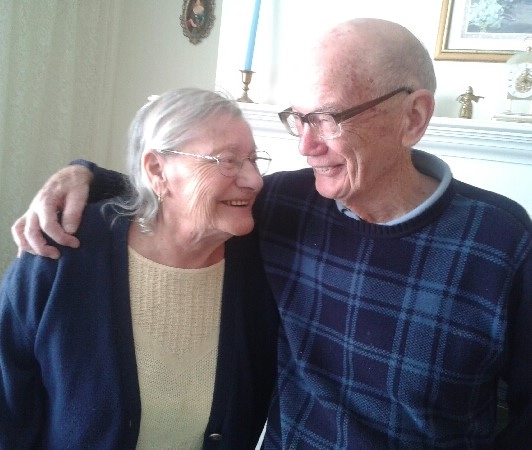
“Inga, I’m trying to learn the words to ‘Albert and the Lion.’ Can you help me?” I began. “There’s a famous seaside place called Blackpool.” Inga recited the next line.
“That’s noted for fresh air and fun.”
Together we voiced. “And Mr. and Mrs. Ramsbottom went there, with young Albert their son.” Inga laughed as we continued our duet until the nurse arrived. The nurse took her hand and led Inga off to her suite, both were smiling. I took the elevator up to my suite. It felt so good to be able to help someone.
I didn’t sleep well that night. That was normal for me. I had developed an extremely poor sleep pattern in the years that I was Joanie’s caregiver. As with all the other aspects of caregiving, I learned to cope. Each long night as I lay by Joanie’s side, I would practice what I now know as meditation. I would lie still and listen to my breathing. My thoughts were, if I am resting my body, I will be fine.
On this night — another long one, my mind went back to my experience with Inga. How she reminded me of my Joanie. I thought of the whole range of emotions that I had gone through in my years of caregiving. The earlier years, my ‘learning’ years, the mood swings as both of us faced a whole new world. Joanie, a world of confusion and fear. My world, one of desperation and despair. How will I cope? Where and when will this journey end?
I learned to cope. I learned to live with a loved one with dementia. As I lay still, I looked back on all the lessons I learned.
If I can help just one family caregiver, I will have achieved something.
I must caution the readers that I have no professional education on the subject. I feel that my journey through dementia with my lovely Joanie qualifies me to offer advice to the family caregivers of loved ones that are stricken with the debilitating Alzheimer’s disease or other brain disorders that are collectively named dementia.
The number one lesson, our loved ones with dementia are still our loved ones.
They are still our loving husband, wife, brother, sister, mom, dad, grandfather, grandmother, aunt, uncle, or friend. They have a progressive brain disease that affects their thoughts and memory.
There is no reason to stop loving them. Joanie never stopped loving me. Your loved one will not stop loving you. There may be times when you question that last sentence, but it’s true.
If you have a loved one with dementia, I hope you have sought professional advice on ascertaining your loved one’s condition. Not having the condition diagnosed does not mean that it does not exist. Denial does not delay its progression.
Short-term memory loss is often one of the first symptoms. Your loved one may repeat questions or statements. For instance, “What day is it today?” If you feel exasperated hearing the question repeated and answer, “I’ve just told you.,” Your voice and body language will cause your loved one to become aggressive and hostile.
There will be times when you are not at your best and lose patience with your loved one. He or she will forget your squabble in a moment. Lack of short-term memory will ensure that. The harsh words you shared will be with you for a long time.
Before my Joanie was admitted into a continuous care centre, we lived in a bungalow in Acadia in the southeast of Calgary. We spent long summer afternoons sitting on our favourite chairs in the sunroom, enjoying our beautiful garden. As the kids would say, ‘just chilling.’ A couple of beers for me, for Joan, a glass or two of burgundy. Each afternoon I’d talk of the happy memories I had of our fifty-seven years of marriage. I’d talk of the wonderful places we’d visited or lived in and all the lovely people that we met. I am sure Joanie didn’t have those memories. That’s okay, she was enjoying the sound of my voice. Those quiet days hold poignant memories for me that will last forever.
My advice to all family caregivers is please accept all the help offered to share the care of your loved one. I should have taken advantage of Alberta Health resources a lot sooner than I did.
The home care services that are available will enable you to grab a few hours of respite. You will find that you can entrust your loved one to a professional caregiver and know that they will be in good hands.
My biggest error was not seeking help in a timely fashion. As the years ticked by, I had become adamant that I was the only one that Joan would accept as a caregiver companion.
I continually declined the offers of help from friends and family. My love for Joanie made me blind to my own welfare. I was sacrificing my own health and well-being by taking on the sole responsibility of caring for Joan. I know now that I was wrong. Our family doctor recognized that I needed to get professional caregivers involved in Joan’s daily life. His advice led me to the actions that I should have taken years earlier.
Family caregivers, please be aware of your own health, both physical and mental. It is just as important as your loved ones.
It took me a while, but I learned that there was no reason to hide my loved one’s condition from my friends and family. Why? Because, in the beginning, I thought that there was a stigma attached to dementia. I learned that it is a disease, it’s not something that should be hidden. There should be no shame or need to be embarrassed.
Society is recognizing that dementia can be discussed and accepted openly. I did encounter some people that did not know how to react to my Joanie’s “irrational” behaviour. I also found that most people were kind and considerate.
We made regular trips to one of the local shopping malls. I made sure that we included a visit to the Dollar Store. I’d give Joanie a $10 or $20 bill and she would spend a blissful half hour or so ‘shopping.’ I sat on a bench outside the store. It didn’t matter to me what she purchased; my Joanie was happy. Our pantry and cupboards filled up with some weird stuff. No big deal. One thing Joanie purchased, which I didn’t notice for a couple of days, was a little imitation parchment scroll. It was a homily written by Larry S. Chenggies. titled ‘Accept Me,’
This is how it began:
“I am I. Do not change me.” It went on for a few lines, with the last line, “I am I… and I like being what I am… Me.”
Joan had signed it and hung it on the inside of one of the kitchen cupboards. I still have it. Another precious memory.
Joan’s dementia was the focus of my life. I woke up each morning knowing that my day would be spent caring for Joan and ministering to her needs. Each night, I would go to sleep knowing that we had got through another day together.
Despair is an ugly word, please don’t let it into your thoughts. I admit, in the early days, I did. There will be good times to compensate for the times that are difficult. I tried to recall special memories of happy days each time I felt low. You might feel resentment. Why you? This is where your love will be tested. In my case, I remembered one of our wedding vows. “In sickness and in health.” I’m sure my Joanie would have stayed in love with me and taken care of me if our roles were reversed.
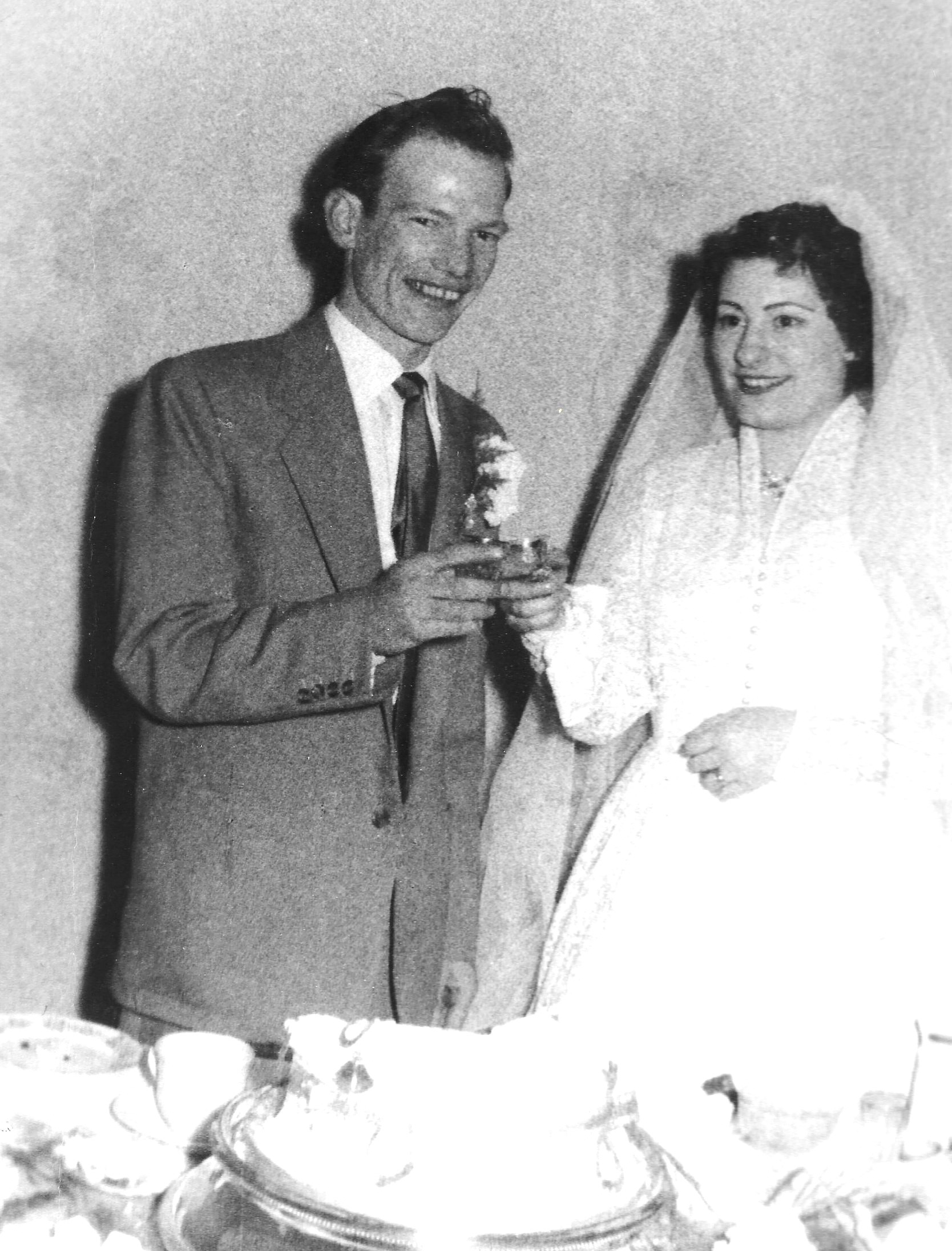
Something that gave me pleasure was the way Joan behaved in social occasions when she was around other people. She greeted everyone as though they were the best of friends. She didn’t distinguish between store clerks and medical specialists; everyone was a recipient of her charm and warm smile. I was careful not to interfere with her interactions. The puzzled looks that I sometimes received from people meeting Joan for the first time were priceless. I occasionally used the phrase, cognitive degeneration, to explain anything inappropriate that Joan may have said or done. Joan never reacted negatively.
Social interaction was important to me. We needed to maintain contact with family and friends. When we were with them, Joanie was always in the forefront, she was no shrinking violet. Everyone had fun with her. They understood and ignored her social missteps. There was never a need to apologize or attempt to explain away Joanie’s dementia inspired, irrational behaviour. It’s a sickness. Would you apologize for your loved one having a broken leg or breast cancer?
There are still some people in our world that do not know how to engage with people with dementia. Stigma needs to be obliterated. There is no shame attached to dementia. I know one lady who used to talk to Joan in a loud voice, perhaps she thought Joan might understand her better. I wanted explain. “It’s Joanie’s brain that is damaged, not her ears.” It distressed me when some people would whisper to me in Joan’s presence, usually, they’d tell me of someone they know with the same condition.
Were they trying to console me or just making conversation? I needed my friends to socialize with and help take my mind away from my everyday life, not constantly remind me of my situation.
I still carry a heavy load of guilt because of my misdirected pride when I was caring for Joanie. Had I accepted help earlier, things would have been different. If I had trusted others to help me care for my loved one, I would have been able to get some respite. My health would not have gone downhill so quickly. I would have been fit enough to keep Joanie at home longer. Perhaps she would have lived longer. I don’t want you to own the shroud of guilt that I still wear.
I’ll repeat my advice to all family caregivers. Please accept all the help offered by family and friends. Share the care. It’s what I should have done. I should also have taken advantage of the Alberta Health programs a lot sooner. The organization that I should have turned to, early in our journey was the Alzheimer Society of Calgary.
Since becoming a member of the society, I have had the opportunity to observe how the professional staff and highly qualified navigators are helping so many local people. The frequent information sessions and seminars that the society presents, are often the first steps that family caregivers take in their quest for answers.
Another regret. Another lesson learned too late. Don’t make my mistake. If you live in the Calgary area, call them at 403 290 0110. For all other areas of Canada call 1 877 569 4357 or the Alzheimer Society in your area.
At the residence where I live, we have a small number of residents that present symptoms of the early stages of dementia as they reach an advanced age. They are living in their own world with no worries. They are part of our family, and we treat them with respect. If they can’t find their room, we escort them, without any admonishments or harsh words. If they’ve lost their keys, we’ll help look for them. Everything is cordial. That’s what loving families do.
I have observed a couple of these same residents when they are visited by their sons or daughters. Their faces are unhappy. Why? Their children are spending precious time trying to prevent their parent’s condition from getting worse. Too many times, have I heard the words, “Mom, when’s your birthday? Do you know how old you are? How many children do you have? Do you remember where you used to live?” I have had to bite my tongue more than a few times, listening to those pointless questions. What I wanted to say and needed to say was, “Can’t you just allow your mom to enjoy your company?”
Questions that your loved one can’t answer, only cause frustration and anger. Why not spend your time telling mom or dad that you have wonderful memories and how you’d love to share them? Tell them of the joy they have brought into your life. How much you love them. I know from experience that your loved one will be happy if you are happy.
I have also encountered loving family members who have learned the art of treating their mom or dad with love and respect. The happiness on the stricken one’s faces in the presence of a loving family member always makes me smile.
To all family caregivers, my very best wishes to you. Stay strong.
Ron E. Freckleton
Author of “Our Time to Say Goodbye — A couple’s journey through dementia", and recipient of a 2025 Top 7 over 70 award in Calgary.
%201.svg)


